Deep learning is a subset of machine learning, not a separate alternative. For industrial visual inspection, the practical choice is often between conventional machine learning, which uses more explicitly engineered features, and deep learning, which learns visual features from image data. Neither is universally better. Choose based on the inspection task, the images and labels you can collect, how you’ll evaluate performance, and the production line’s constraints.
That distinction matters because “use AI” doesn’t define an inspection method. A fixed, measurable check may be better suited to conventional machine vision or a simpler model; variable surface defects may be worth testing with a learned image model. In either case, the camera, lighting and production conditions can limit performance regardless of the algorithm. The National Institute of Advanced Industrial Science and Technology’s reference guide to machine-learning quality management emphasizes defining the problem, covering relevant operating cases and checking execution conditions.
Before you start
- Define the inspection decision. Specify what counts as acceptable or defective, and what the system should do when an image is unclear.
- Describe the task. Is it a fixed measurement, a presence check, classification of known defects, defect localization or detection of unusual appearances?
- Check image quality. Confirm that the defect is visible with the planned camera, lens, lighting, angle and part presentation. A model cannot recover visual information that the image does not contain. (Vision Systems Design guide)
- Inventory representative data. Include good and defective parts across normal variation, such as shifts, finishes, lots, positions and lighting changes. Near-duplicate frames are not a substitute for distinct production conditions.
- Set evaluation criteria first. Decide how you’ll measure missed defects, false rejects, processing time and performance on important subgroups before comparing models.
What’s the difference between machine learning and deep learning?
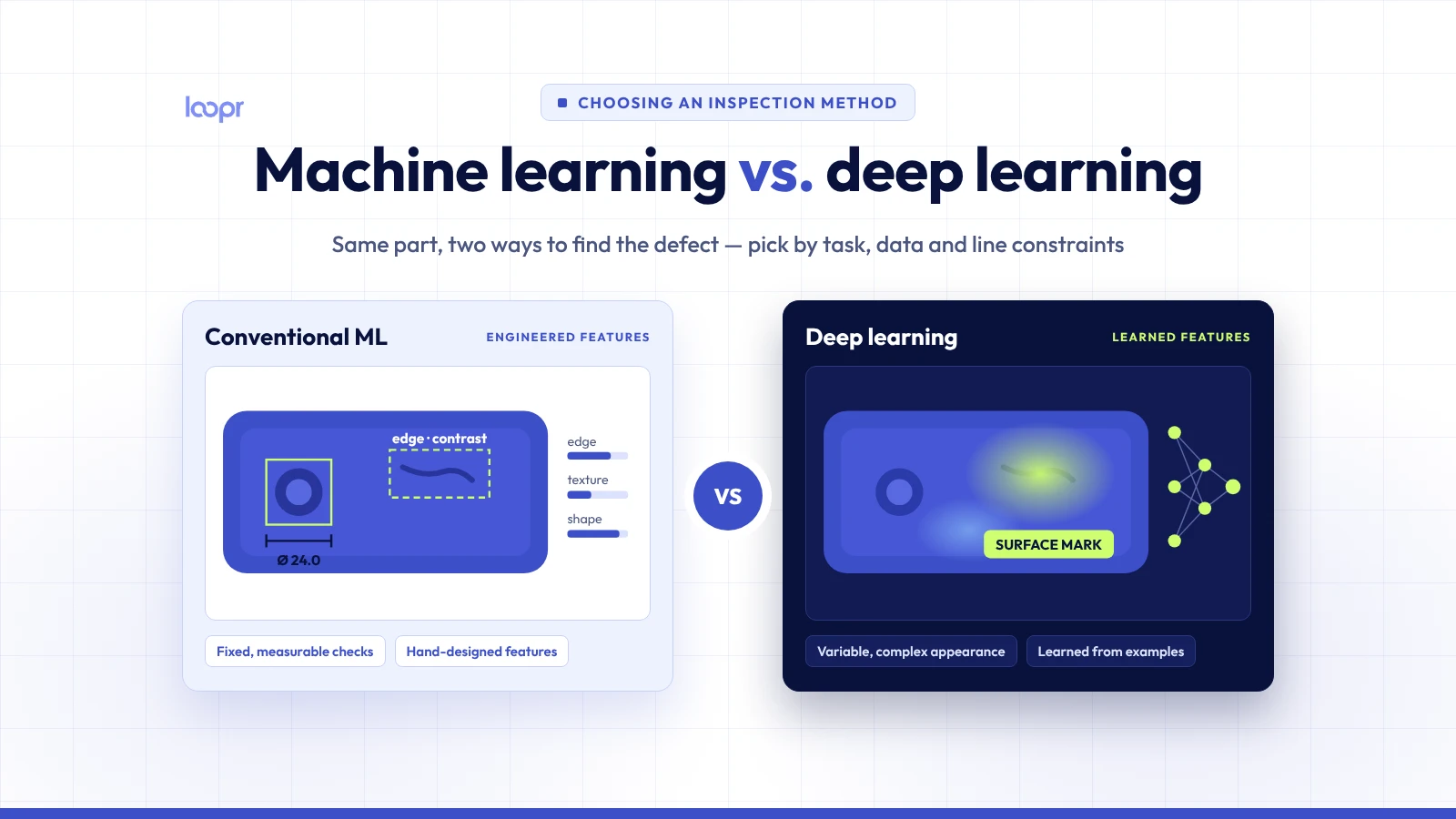
Machine learning (ML) is a broad family of methods that learn patterns from data. In image inspection, a conventional ML workflow may first calculate or select features—such as edge strength, texture, color or shape—and then use a model to classify them.
Deep learning (DL) is a subset of ML that uses multilayer neural networks. For image tasks, these networks can learn useful visual features during training rather than relying on an engineer to specify every feature in advance. That doesn’t eliminate engineering: task definition, image capture, representative data, labels and validation still matter.
“Machine vision” is broader than either category. A complete inspection station includes image capture and processing, and may combine rule-based operations, conventional ML, deep learning and human review. For foundational context, see our introduction to AI visual inspection, which covers how camera images, training data and inspection models fit together.
How do the approaches compare for inspection work?
| Decision factor | Conventional machine learning | Deep learning |
|---|---|---|
| Task fit | Worth testing when the feature is well defined and can be described with measurable image features. | Worth testing when appearance is complex or variation makes hand-designed features difficult. |
| Feature engineering | The team typically selects or calculates image features, then trains a model on them. | The network learns visual features from training images; model design and data preparation still require expertise. |
| Labels and data | Needs data suited to the selected features and task. It may need fewer examples in some narrow cases, but that is not guaranteed. | Needs representative data and suitable labels for the task. Data needs vary by problem and model; there is no reliable universal image-count rule. |
| Evaluation | Evaluate the complete pipeline, including feature extraction, thresholds and model decisions. | Evaluate on held-out, representative images and production conditions—not just training performance. |
| Deployment | Check total processing time and compatibility with the station’s hardware and software. | Check model size, inference time, memory and hardware requirements in the intended environment. |
| Ongoing validation | Recheck when image conditions or product characteristics change; engineered features can also be sensitive to variation. | Recheck when data, products, lighting or processes change. A model that performed well at launch may not cover new conditions. |
These are tendencies, not guarantees. A high-quality labeled dataset does not make a deep model automatically appropriate, and a hand-designed feature pipeline is not automatically simpler to maintain. The AIST guide recommends assessing coverage of relevant cases and high-risk conditions. A machine-vision technical guide also notes that hardware and deployment conditions can affect whether a trained network runs reliably in production. (AIST guide; Vision Systems Design guide)
How should you choose for a specific inspection task?
Start with the physical inspection decision, not the model family.
- Try simpler methods when the requirement is explicit. If the check is a known position, size or presence requirement under stable imaging conditions, test conventional machine vision first. It may be more direct to specify and validate than an ML model.
- Consider conventional ML when useful features are identifiable. If defects can be separated using a manageable set of measurable attributes, a conventional ML workflow may be a reasonable candidate. Verify that those attributes remain stable across expected product and process variation.
- Consider deep learning when appearance is hard to describe with fixed features. Irregular surface marks, variable textures or complex visual context may justify testing a neural network. Treat this as a hypothesis to validate, not a promise of better results.
- Compare candidates using the same evidence. Use the same representative held-out images, pass/fail criteria and production constraints. Review missed defects and false rejects by defect type and operating condition, rather than relying on a single overall score.
- Include the station in the test. Measure whether the complete camera-to-decision path meets cycle-time and hardware requirements. An offline model score does not establish performance on the line.
Lighting, optics and cameras must produce images in which the feature of interest is visible. That is true whether the inspection logic uses rules, conventional ML or deep learning. See our guide to machine-vision system components for imaging setup considerations. (Vision Systems Design guide)
What trade-offs should you plan for?
Data and labels: Deep learning may reduce the need to hand-design image features, but it doesn’t remove the work of collecting representative images and defining reliable labels. If defects are rare, don’t assume synthetic variations or augmentation prove performance on real production images. Keep real, held-out examples for evaluation.
Explainability and troubleshooting: A model that returns a score may not explain the physical cause of a defect. Consider what evidence engineers and operators need to review a rejection and investigate disputed results. If the decision must be explained in a specific way, make that a selection criterion.
Speed and resources: Test inference on the intended hardware, at the actual image size and expected line rate. A model that works on a development workstation may not meet the station’s latency or memory limits. The AIST guide identifies consistency between development and operating environments, as well as hardware requirements, as dependability concerns.
Changing conditions: New product variants, tooling, finishes, camera positions or lighting can change the images a model sees. Define who reviews performance, how new examples are assessed and what triggers revalidation or retraining. Don’t treat retraining as an automatic fix; evaluate the updated system again against representative data.
For guidance on involving inspectors in model review, see our article on when to review AI visual inspection results.
Worked example: checking a machined housing
This illustrative example is made up to explain the decision process.
A plant wants to inspect a machined housing for a missing plug and shallow surface marks. The plug is in a repeatable location, and the station captures a stable view. Engineers might first test a direct presence or location check for the plug. If it is robust, a learned model may not be necessary for that feature.
The surface marks vary in shape and contrast across finishes. The team could compare a feature-based ML approach with deep learning using the same held-out images, including normal finish variation and known mark types. They would review missed defects, false rejects, cycle time and hardware fit. The preferred method is the one that meets the agreed requirements under actual line conditions—not necessarily the more advanced-sounding model.
Decision checklist
Answer yes or no before committing to an approach:
- Can we define the defect or acceptance condition in a way inspectors apply consistently?
- Can the planned imaging setup make the target feature clearly visible?
- Do we have representative examples across relevant parts, finishes and operating conditions?
- Can we label the data consistently, including ambiguous cases?
- Have we identified the quality risk and cost of a missed defect versus a false reject?
- Have we tested performance on held-out images that were not used to develop the model?
- Does the complete system meet the line’s cycle-time, hardware and maintenance constraints?
- Do we have a process to review results and revalidate after relevant changes?
A “no” on data, image quality or evaluation is a reason to improve the inspection plan before debating model type.
What can these approaches not do?
Neither conventional ML nor deep learning can compensate for an inspection target that is not visible or a defect definition that varies from person to person. Both can fail on conditions they have not been properly tested against, including unusual lighting, new product variants and rare defect types. A successful trial on a narrow sample does not, by itself, establish reliable production performance.
Visual inspection is not the right method for every quality characteristic. If a requirement concerns an internal feature or a precise measurement that the image cannot resolve, use a suitable measurement method or another inspection technology. Keep human review available for uncertain, high-risk or disputed outcomes, and confirm the inspection system’s limits with the people responsible for product quality and process safety.
Next step: run one controlled comparison
Select one inspection task and write down the defect definition, representative operating conditions, acceptable miss/false-reject trade-off and line timing requirement. Then ask your vision team to compare the simplest plausible approach with a deep-learning candidate using the same held-out images. Record where each method fails before deciding whether a larger data-collection or deployment effort is justified.
Considering AI visual inspection for your line? Explore the Loopr platform to see whether it fits your inspection needs.
Frequently asked questions
Is deep learning better than machine learning for visual inspection?
Deep learning is a type of machine learning and is not automatically better for every inspection. Compare methods using representative images and the same quality, speed and deployment requirements.
How much labeled data do I need for deep-learning inspection?
There is no universal image count that guarantees a useful model. Data needs depend on the task, variation, labels and model. Evaluate with representative examples and keep separate data for testing.
When should I use traditional machine vision instead of AI?
For a stable, clearly defined task such as a fixed-position or dimensional check, conventional machine-vision rules may be a more direct option. Test them first when appropriate, and consider ML if the defined requirement is not met.
What is the difference between machine learning and deep learning?
Machine learning is the broad category of methods that learn patterns from data. Deep learning is a subset that uses multilayer neural networks, which can learn image features from examples rather than relying entirely on manually specified features.
Sources
- Reference Guide to Machine Learning Quality Management — National Institute of Advanced Industrial Science and Technology (AIST), version 1.3. Discusses problem definition, data coverage, high-risk cases, evaluation and deployment-environment dependability.
- Designing effective traditional and deep learning based inspection systems — Vision Systems Design: Vision Insights. Publication date not confirmed in the accessed document. Supports discussion of imaging setup, training/test separation and deployment hardware.
- Introduction to AI Visual Inspection: Understanding the Basics — Loopr AI, August 1, 2024. Existing internal article reviewed for topic overlap and linked for foundational context.