Not as a blanket replacement. Multimodal LLMs can help teams explore defect-detection ideas, but production inspection requires evidence that a system makes the right decision consistently. Whether an LLM or a specialized vision system is a better fit depends on the defect, the required output, and the line’s operating constraints.
Quality teams face a practical trade-off: a general-purpose model may be quick to try, while a task-specific vision system may need more preparation but offer tighter control over a defined inspection. Published results can inform the decision, but they do not predict performance on your parts. One industrial benchmark reported 74.9% average accuracy for GPT-4o models across its test tasks. A 2026 LNG-manufacturing study found that general-purpose models’ defect-localization performance varied substantially before domain-specific adaptation. (MMAD benchmark; LNG-manufacturing study)
Before you start: define the inspection decision
Before comparing models, make the inspection task specific enough to test.
- Part and feature: Identify the product, surface, or region to inspect.
- Defect definition: Describe what counts as a defect and what variation is acceptable.
- Required decision: Decide whether the system must locate a region, classify a defect, produce a pass/fail result, or support a person’s review.
- Error consequences: Consider what a missed defect and an unnecessary flag mean for your process.
- Current baseline: Record how the inspection is performed today and how results are judged.
- Image conditions: Check that the camera, lighting, focus, part position, and image timing make the target defect visible.
A model cannot recover visual evidence that was never captured. Loopr’s guide to image capture for high-speed defect detection explains why image quality is a practical starting point.
What do “LLM” and “traditional vision AI” mean here?
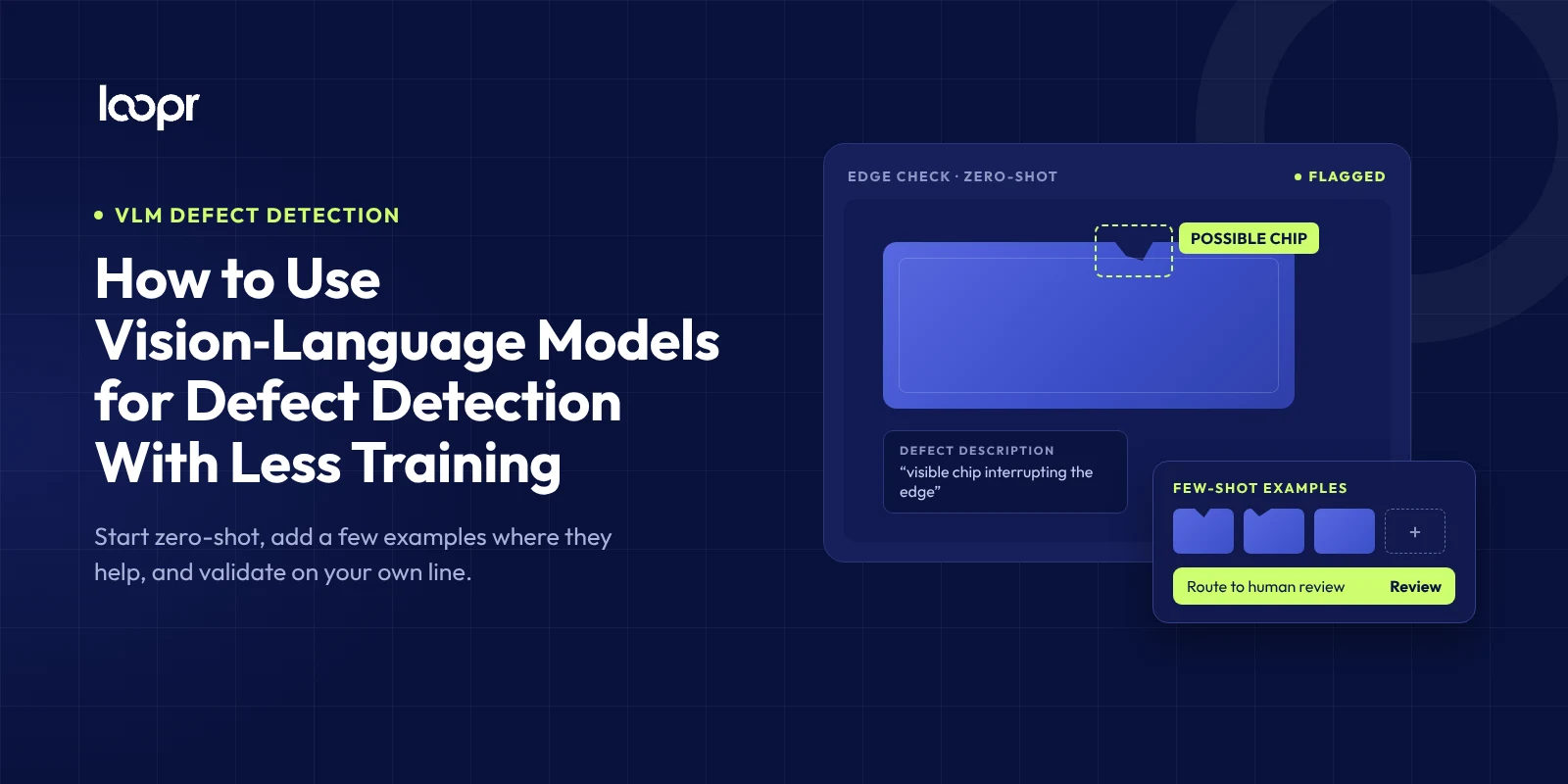
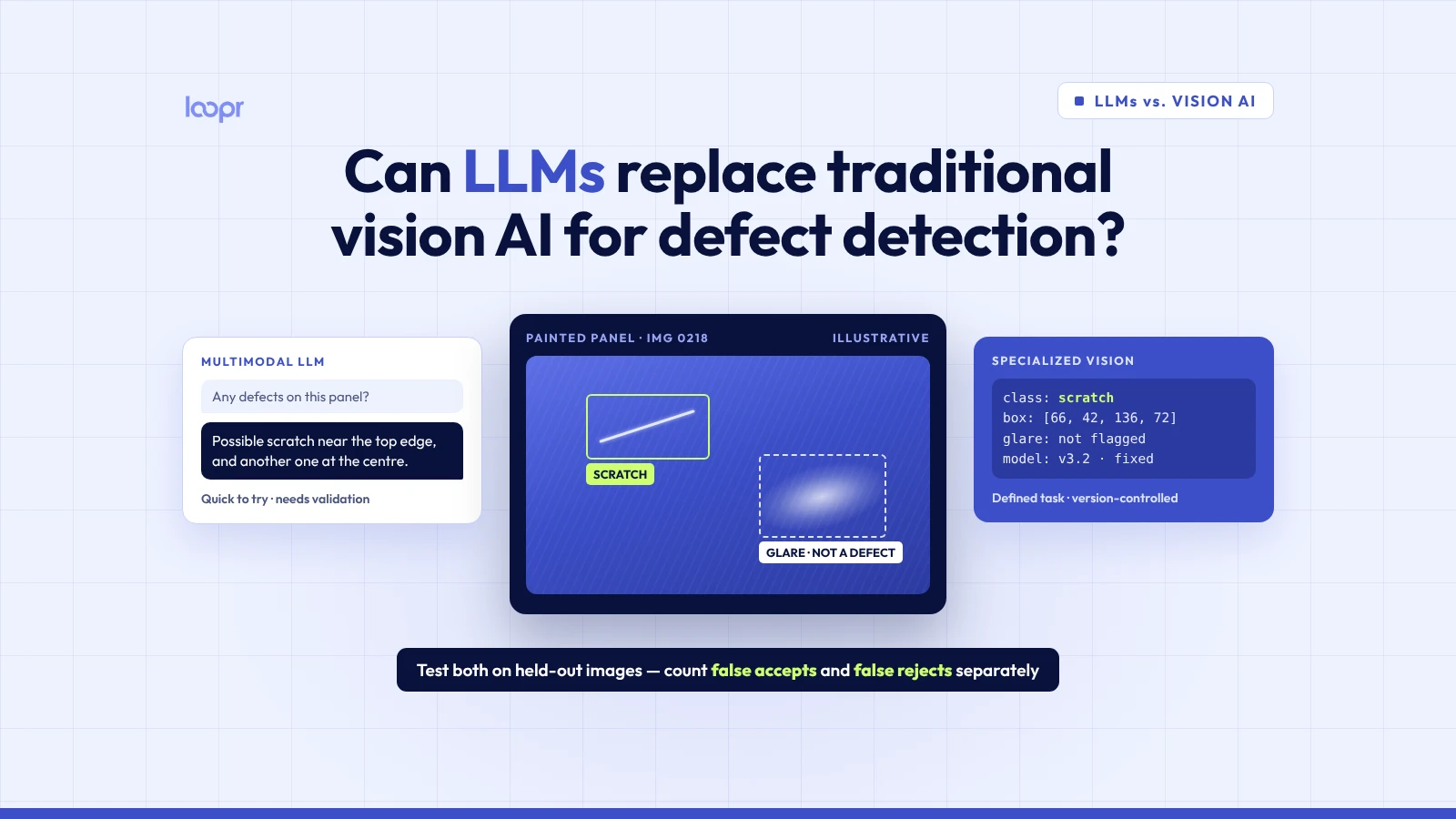
A multimodal LLM, often called a vision-language model (VLM), accepts images as well as text and can answer questions about visual content. A prompt might ask it to identify a possible scratch and describe where it appears. Its response may be conversational, though some systems also support structured outputs.
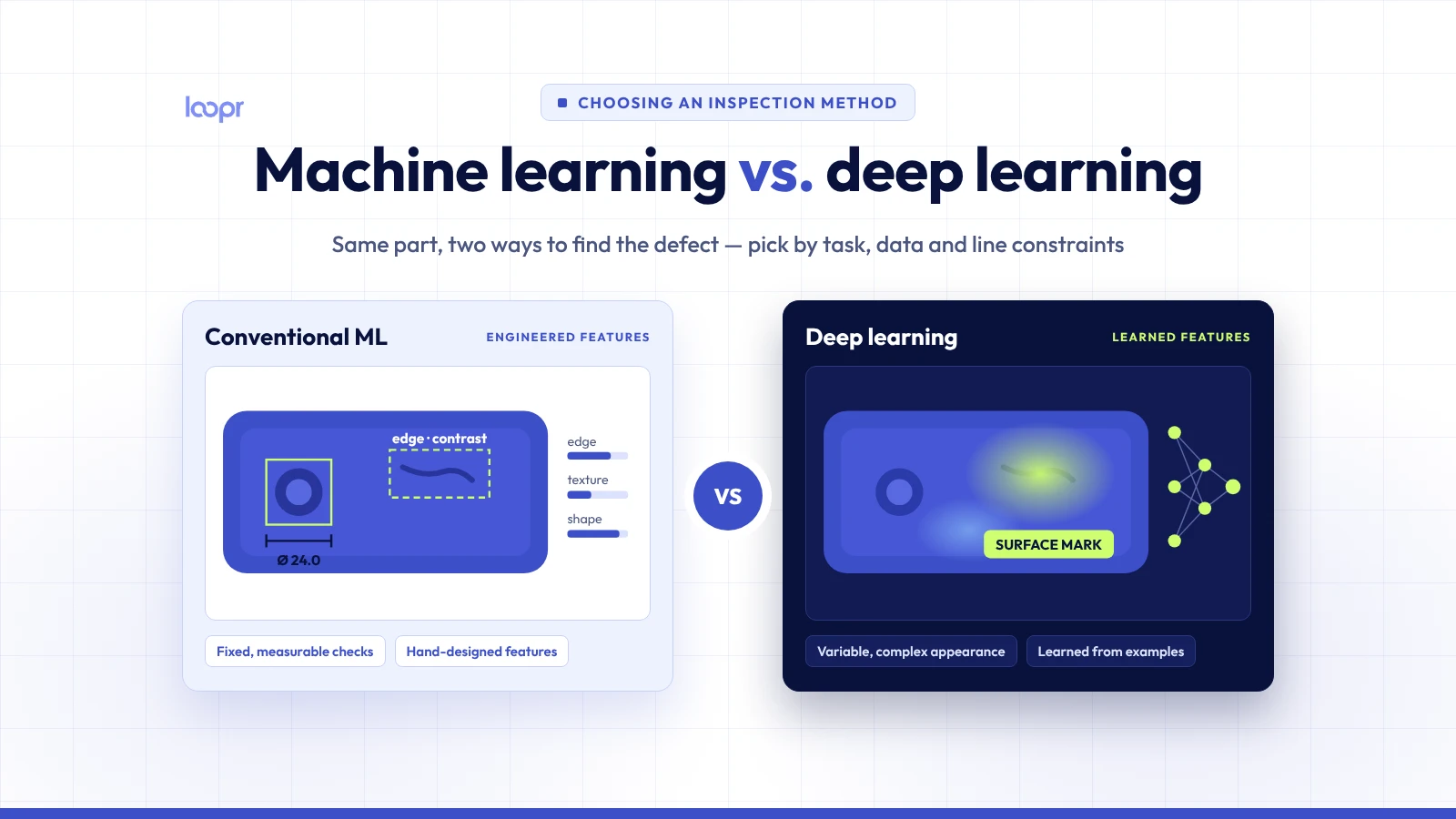
A specialized vision AI system is built or configured for a narrower visual task, such as locating a particular class of defect. It may use machine-learning models trained or adapted for that task, or conventional machine-vision methods when the visual rule is clear. “Traditional” does not refer to one specific technology, and not every vision system requires the same amount of training data.
These categories can overlap. Vision-language systems can be adapted for industrial inspection, and a production system can combine vision models with language-based tools. The useful comparison is not “new versus old,” but whether a specific system can meet the requirements of a specific inspection. For an overview of VLM pilots, see our vision-language model defect-detection guide.
How do the approaches compare?
| Consideration | Multimodal LLM or VLM | Specialized vision system |
|---|---|---|
| First experiment | Can be quick to try with prompts and existing images; results still need validation. | Often needs more task definition and setup; effort depends on the method and available data. |
| Unseen defect descriptions | Natural-language prompts can help explore new categories, but do not guarantee reliable detection. | Usually designed around specified tasks; new defect types may require configuration, examples, or model changes. |
| Defect location and measurement | May describe an image well, but localization and measurement must be tested for the required precision. | Can be designed around defined locations, regions, or measurements. |
| Output format | May produce useful descriptions; machine-readable fields and decision rules need verification. | Can be configured around the output format the inspection process requires. |
| Repeatability and change control | Provider, model version, prompt, or settings can affect behavior; record and retest changes. | Deployment and model changes can be controlled by the team, but still require testing and change management. |
| Line speed and deployment | Check latency, connectivity, throughput, data handling, and service availability for the intended setup. | Can be selected or designed for the line’s throughput and deployment constraints; validate the complete system. |
| Potential initial role | Explore a use case, support review, or test whether a task is worth pursuing. | Perform a clearly defined, repeatable inspection when validated against line requirements. |
This table is a decision aid, not a claim that every LLM or vision system behaves the same way. The industrial MMAD benchmark evaluated multiple tasks across industrial images and reported 74.9% average accuracy for GPT-4o models on its benchmark. A separate study, published April 27, 2026, adapted large vision-language models for LNG tank manufacturing and reported limited localization performance before adaptation on its test set. These results illustrate why a model family or general benchmark score cannot substitute for testing your own inspection. (MMAD; LNG study)
When might an LLM be useful, and when should you be cautious?
An LLM or VLM may be useful for a prototype when you want to explore whether a visual condition can be described clearly, test a low-volume workflow, or help a reviewer interpret candidate findings. It may also help organize inspection notes after another system has identified or flagged a region. A quick experiment can help answer “Is this worth investigating?” without answering “Can this control production quality?”
Be cautious about using a general-purpose model as the sole production decision-maker when missed defects have serious consequences, the inspection requires precise localization or measurement, the line has tight response-time requirements, or results must remain stable across repeated runs and model updates. Prompt design and structured outputs do not automatically resolve those concerns.
Define a validation plan before trying to improve the system. Keep a representative evaluation set separate from examples used to tune prompts or adapt a model. Record false accepts and false rejects separately, test relevant product variants and capture conditions, and document the model, configuration, and decision threshold. NIST’s AI Risk Management Framework calls for documented, ongoing testing, evaluation, verification, and validation. This is a useful general discipline, not a manufacturing certification. NIST AI RMF
What are the trade-offs?
The main trade-off is between speed of exploration and control over a specific inspection. An LLM may make an early experiment accessible, but production use adds work: checking outputs, handling errors, tracking model changes, and establishing whether results meet the line’s criteria. A specialized system may require more setup, but can be a better fit when the task and acceptance rules are stable.
Measure cost in the actual operating context rather than inferring it from a small image test. Compare the full workflow: image volume, images per part, inference and integration costs, latency, network dependencies, maintenance, and the cost of human review. Loopr's initial experiment raised inference cost and network constraints as concerns but did not measure cost, latency or throughput. Treat these as evaluation questions, not demonstrated findings.
Likewise, do not assume that a specialized vision system is inherently repeatable or that an LLM is inherently unsuitable for production. Test the system you plan to deploy, including its camera and software path, and re-evaluate after meaningful changes. Our guide to choosing an AI visual inspection system discusses how to frame that decision.
What did Loopr’s paint-surface experiment show?
In an initial internal experiment, Loopr tested multiple vision-capable LLMs on 500 paint-surface images involving scratches, dents, insufficiently painted areas, and watermarks. The team observed over 80% accuracy in this first test. It also noted concerns about repeatability, structured outputs, model-version changes, task-specific improvement, and scaling.
Because this was an exploratory first test, the figure is not a general benchmark or a production result. A single overall score does not show how each defect type performed, how often good surfaces were flagged, or whether results hold across repeated runs and model versions.
The narrower practical lesson is that a fast demonstration can be informative, but a single aggregate score cannot establish production readiness. The next test should examine the errors and operating requirements that matter for the intended inspection.
Worked example (illustrative, not a reported Loopr result): A plant tests an LLM on images of painted housings and finds that it sometimes flags glare as a scratch. The team keeps the existing inspection in place, records false alarms and missed scratches, and compares the LLM with a task-specific vision approach on held-out images. It proceeds only if one approach meets the team’s agreed criteria under the actual lighting and part variation.
Checklist: is your comparison ready?
- Have we defined the defect separately from acceptable surface variation?
- Can the camera capture the smallest or most subtle defect we need to detect?
- Do we know what the output must contain: a flag, a location, a class, a measurement, or a decision?
- Have we chosen evaluation images that were not used to tune the prompt or model?
- Are false accepts and false rejects reported separately?
- Have we repeated tests and documented model versions, prompts, settings, and thresholds?
- Have we tested the system under relevant changes in lighting, product, and part position?
- Have we checked line-speed, connectivity, data-handling, and review requirements?
Limitations: what neither approach guarantees
Neither model type can inspect details absent from the image. Glare, blur, poor focus, occlusion, or a defect smaller than the useful image resolution can undermine any visual method. A clear image is necessary, but does not by itself ensure a correct decision.
A promising score on a small dataset may not represent rare defects, new product variants, or real operating conditions. A model’s output can also be misused if a descriptive answer is treated as a validated pass/fail decision. For consequential quality decisions, keep appropriate human review and an established fallback until the complete inspection process has been evaluated.
Next step: run one controlled comparison
Choose one defect on one part family. Gather representative images, agree on what counts as a miss and a false alarm, and compare your current method with one LLM/VLM prototype and one suitable specialized vision approach, if available. Record the configurations and review the errors with the people responsible for the inspection decision. Do not expand the test until the results answer a specific operational question.
Exploring AI visual inspection for your line? Learn about the Loopr platform.
Frequently asked questions
Can an LLM replace a vision system for defect detection?
Not automatically. A multimodal LLM can be tested for a specific inspection, but replacement requires evidence that the complete system meets the line’s criteria for detection, errors, speed, and change control.
What is the difference between an LLM and a vision-language model?
A text-only LLM processes text, while a vision-language model can process images along with text. For defect detection, the model must be able to evaluate the image. A text-only LLM may still help organize findings supplied by another system.
Is 80% accuracy enough for production defect detection?
Not by itself. Loopr's initial experiment saw over 80% accuracy, but an overall figure does not show which defects were missed or how many good parts were flagged. A production decision needs agreed criteria and a reviewed breakdown of errors.
What is the difference between a multimodal LLM and specialized vision AI?
A multimodal LLM is a general-purpose image-and-language model that can respond to prompts about images. Specialized vision AI is configured or trained for a narrower visual task. Either approach needs validation on the intended line.
Should we use an LLM for a defect-detection prototype?
It can be a way to explore a narrowly defined task, especially if the team already has suitable images. Treat the result as a prototype: preserve the current inspection, test on held-out examples, and document the configuration and errors.