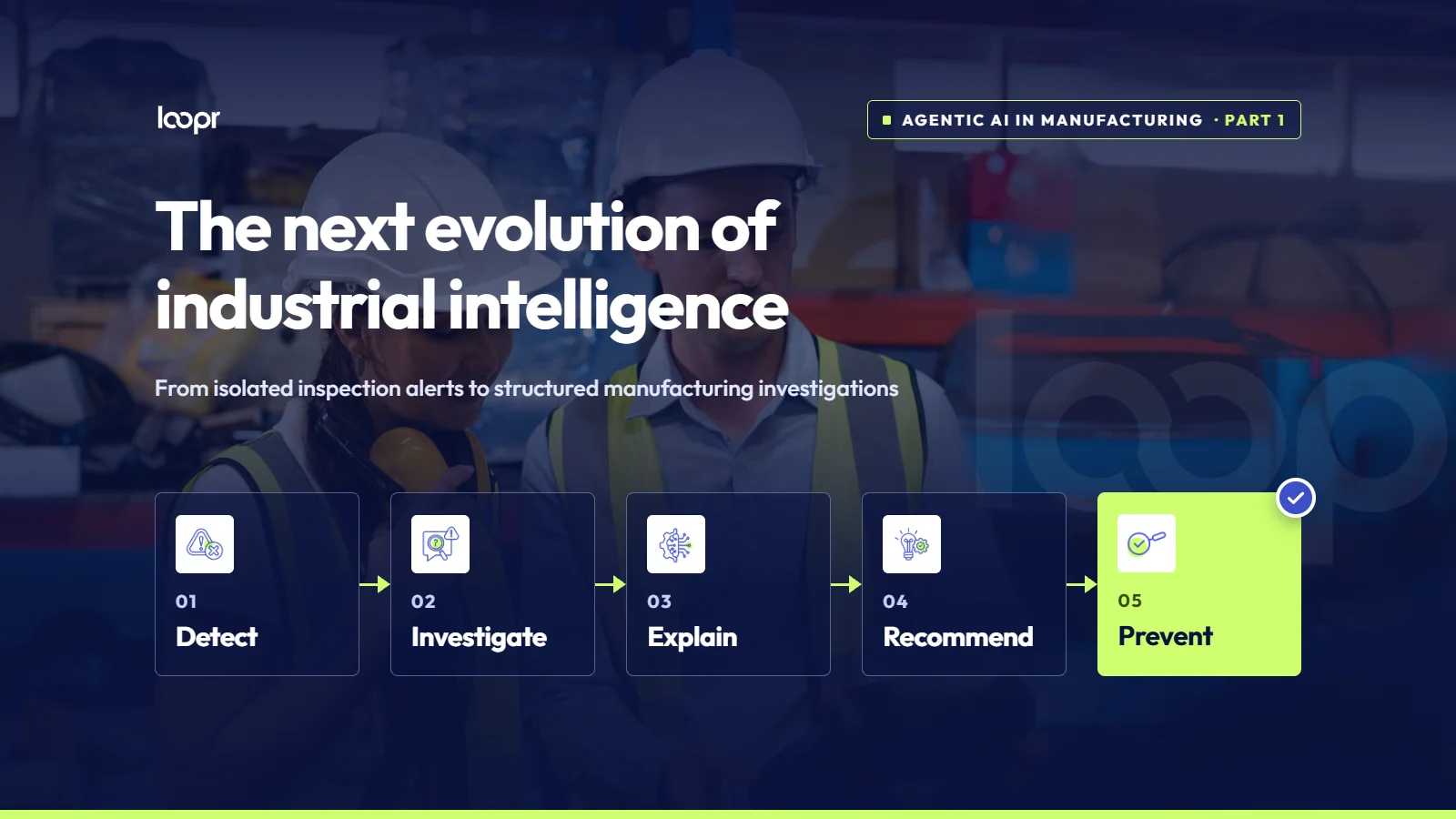
A visual-inspection alarm describes what the system observed. An engineering investigation asks why the observation occurred, whether it reflects a real physical defect and which upstream changes might explain it. The proposed Loopr Process Reasoning & RCA Agent is designed to bridge these steps with evidence-backed reasoning.
A fictional production case: coated-metal panels
Consider a synthetic metal-panel coating operation. Vision inspection identifies surface streaking, edge-finish irregularities, color differences and inconsistent labeling. The automated overall flag rate changes after the site switches its inspection processing pathway. Production teams need to determine whether this is an inspection-method effect, a real process improvement or a combination.
A pathway-level flag-rate change cannot, on its own, establish improved manufacturing yield. Before drawing conclusions, an agent would match equivalent products and time windows, review inspection-rule changes and obtain an independently adjudicated sample of physical units.
Where the initial signals concentrate
In the illustrative component breakdown, surface-coating checks flag most often (24% among applicable inspections), followed by edge finish (13%) and color consistency (10%). Each rate uses the check’s applicable inspection population; missing or not-applicable checks must not silently enter the denominator.
Illustrative: component-level inspection flags
Flagged among applicable inspections (%)
Synthetic example; different checks may have different applicable denominators.
Multiple component flags could indicate a shared coating issue, an image-presentation problem or unrelated defects. The agent should investigate co-occurrence as a clue, not infer one physical root cause automatically.
A second clue: why reinspections matter
Same-session reinspections can change from FAIL to PASS or the reverse. Such shifts may reflect image angle, lighting, model variability, a genuinely corrected part or changed rules. Reviewing paired images and rework records helps distinguish these possibilities.
Illustrative: same-session reinspection outcomes
Linked reinspection pairs
Synthetic counts. Changed decisions require paired image and part-condition review.
The chart shows synthetic linked inspections. Neither a FAIL → PASS transition nor a PASS → FAIL transition independently proves model error. It does indicate which records deserve deeper investigation.
The reasoning sequence
The architecture behind the agent
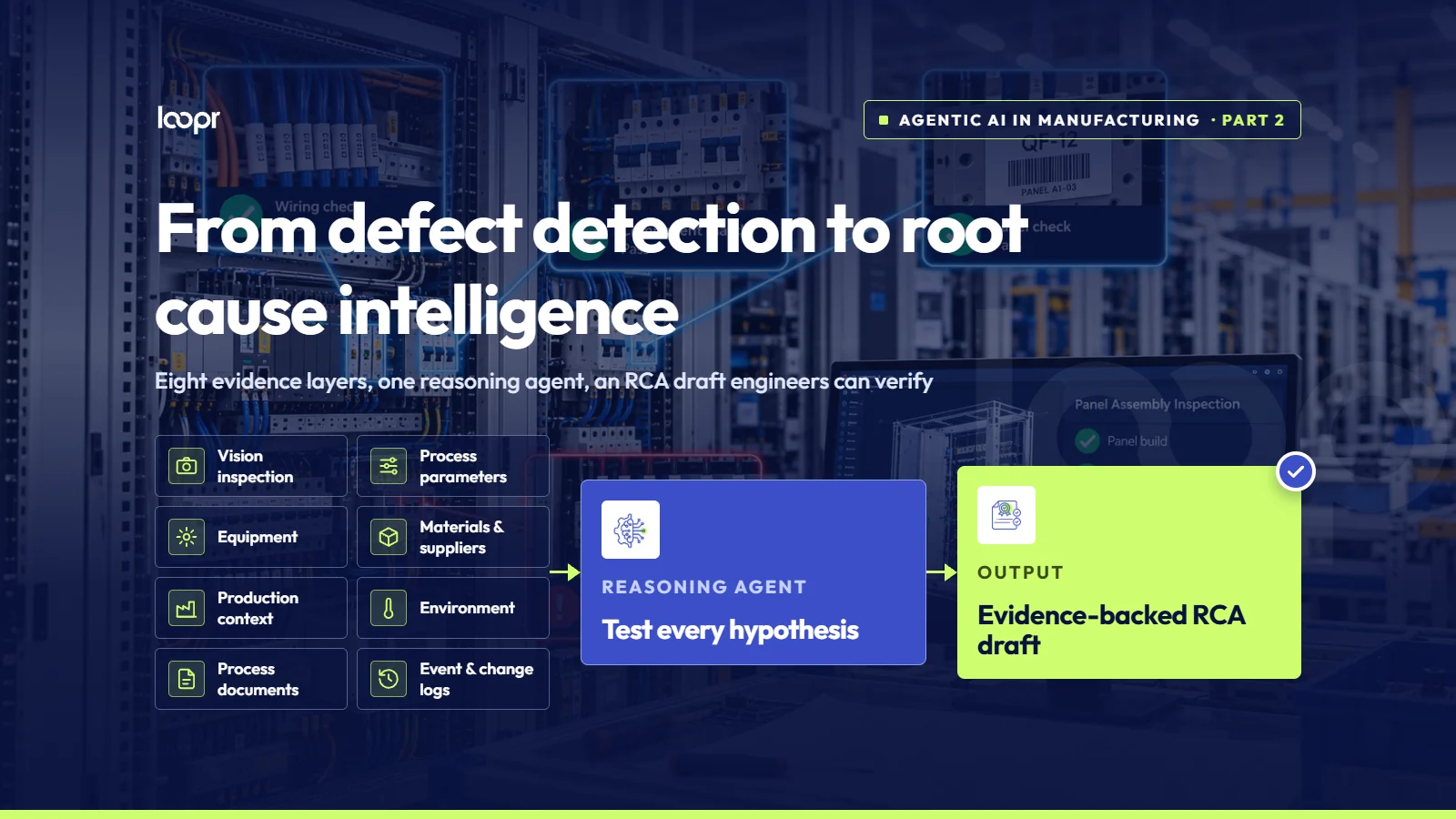
Loopr’s proposed architecture combines eight evidence layers: vision inspection; process parameters; machine/equipment; materials/suppliers; production context; environmental conditions; process documents; and event/change logs. A knowledge graph and time-series store organize relationships and temporal evidence, while a RAG layer retrieves SOPs and historical investigations. LLM tool orchestration and analytical scoring generate an evidence-based RCA draft.
In the coated-panel example, coating temperature instability, material-batch viscosity variation, camera conditions and a change in the inspection pipeline might all be plausible hypotheses. The agent must test each against timestamps, specifications and physical evidence before presenting conclusions.
What a useful pilot measures
Pilot success is measured through time to validated RCA, confirmation of physical defects, false-flag and missed-defect estimates, repeatability across equivalent inspection modes and reduction in recurring issues. A low automated flag rate alone is not a business outcome.
A phased development path
Conclusion
The transition from defect detection to manufacturing intelligence is not about making a more persuasive dashboard. It is about connecting inspection evidence with the process that produced it, documenting uncertainty and helping engineers determine what to verify next. Detect → Reason → Act remains the guiding framework; the final action belongs within an approved manufacturing workflow.
Editorial note: The coated-metal panel case, rates, counts and all charts are fictional illustrations. They are not derived customer performance claims. Architecture and roadmap are adapted from Loopr’s June 2026 Manufacturing Process Reasoning & RCA Agent briefing.