
Loopr unifies inspection execution, Vision AI, and enterprise analytics into a Quality Intelligence System built to close the loop on quality across the manufacturing lifecycle.
A Quality Intelligence System integrates data from every quality touchpoint to provide predictive insights and enable proactive quality management.
Traditional QMS and AOI tools operate in silos, limiting visibility and slowing response to quality issues. Loopr positions itself above these systems, consolidating data and applying AI to deliver enterprise-wide intelligence.
Transform quality management from reactive inspection to proactive data-driven optimization, reducing the cost of poor quality while improving throughput and compliance.
Loopr sits alongside MES and PLCs. It does not replace production systems.
Loopr brings together vision AI, adaptive inspections, and enterprise intelligence to support quality teams across the full inspection lifecycle.
Standardized digital workflows with evidence capture and full traceability
Custom models for complex defect detection with human-in-the-loop and autopilot modes
BOM and CAD-driven inspection rules that adapt to product variations
In development: AI agents that will identify patterns, anomalies, and systemic risks
In development: closed-loop workflows that will recommend corrective actions and optimize outcomes
Complete audit trail with image and video evidence for warranty and compliance
Fixed cameras run hands-free at repeatable, high-throughput stations. Tablets bring the camera to the part on moving lines and for large, variable products. Both check each unit against its own BOM pulled from ERP, run in auto-pilot or co-pilot mode, and log every result with timestamp and operator to the same record.
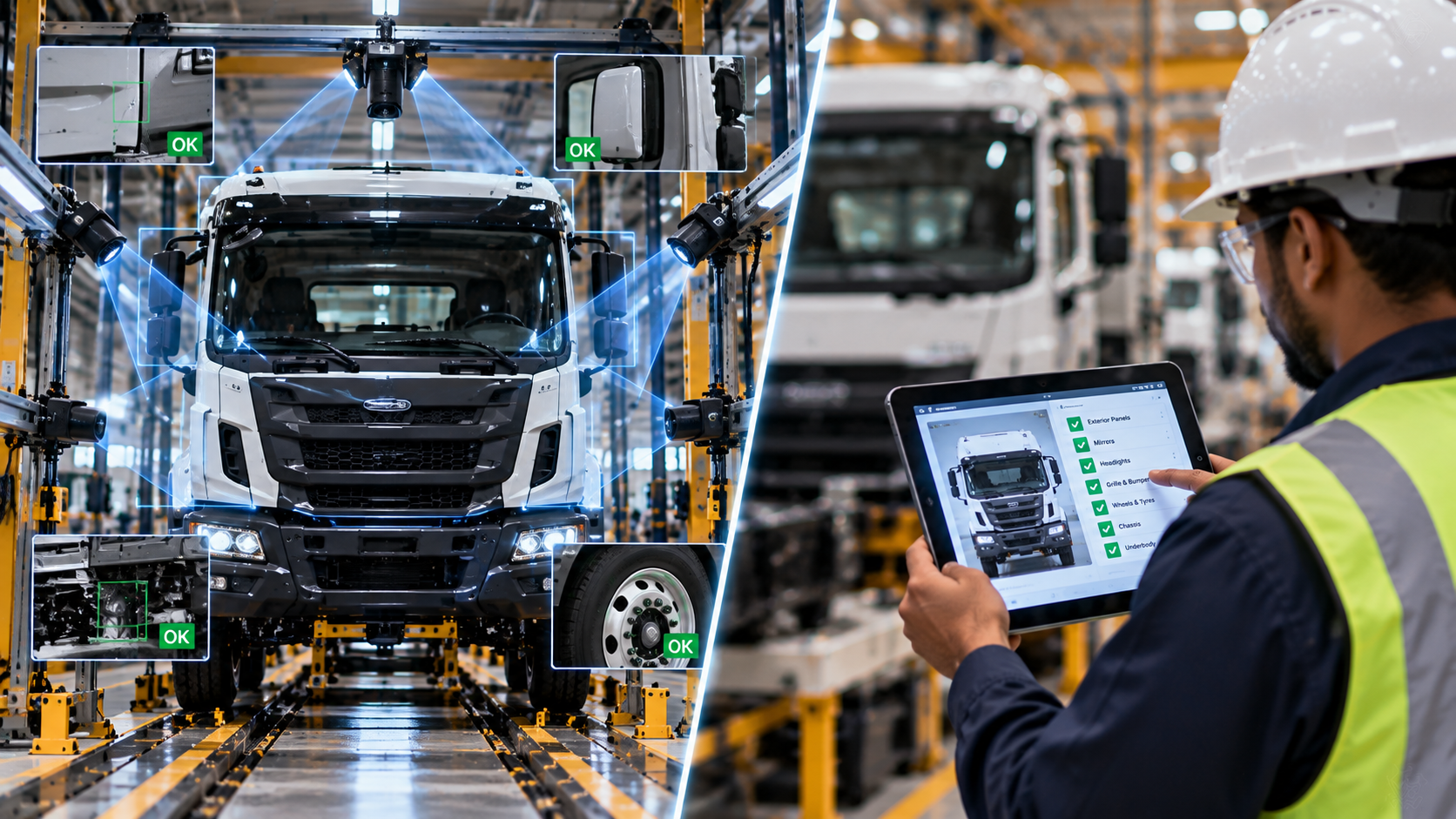
Mounted over the station, it captures every unit automatically as it arrives and checks it against that unit's BOM. Fail conditions can raise an Andon alert or, where a site-specific PLC integration is set up, divert the part, with human review available where you want it.
The operator points a tablet at the assembly and the system checks presence, placement and correct part against the unit's configuration in real time. Bring the camera to the part, not the part to the camera.
Rotor blades in aerospace MRO, flagged early to assess rework feasibility.
Scratches, cracks and inclusions on building-product panels.
Dents on rotor blades during MRO inspection.
Container surface dents on packaging lines, at full line speed.
Bent tips on metal parts, inspected through an existing microscope. Throughput rose from 15 to 60 parts per hour.
Bends on rotor blades in aerospace MRO.
Micro inspection of incomplete welds under a microscope.
Weld presence and bead quality on robotic and manual welds in heavy equipment.
Paint defects on recreational vehicles, with video footage stored against each VIN.
Paint defects on aerospace cabin parts, detected with 94% model accuracy.
Loopr captures visual quality data and connects it to MES and, where integrated, PLC context without disrupting production. Inspection evidence flows into Azure, where it becomes shared quality data for dashboards and Copilot, and for AI agents as they roll out.

Use any input source: IP, thermal, endoscopic and microscope-mounted cameras, fixed or handheld. Cameras connect through a REST API, and where a PLC integration is configured for the site, results can trigger part diversion.
Hardware agnostic. Loopr runs on non-specialized compute and customer-supplied tablets, works with existing fixed cameras and VMS such as Milestone, and can be integrated with robotics.
Built on Azure. Deploy in the cloud, on-premise, or in government cloud with fully air-gapped options, depending on site requirements.
BOMs and work orders come from ERP through REST APIs, or are derived from images depending on the workflow, so each unit is inspected against its own configuration. Results flow to MES, and PLC signalling for part diversion can be added as a site-specific integration. Alerts go out by email and Andon boards, with SMS and Teams through integrations, and data lands in Fabric and Power BI.
Every inspection lands in a structured repository with images, video and metadata. Dashboards and Copilot surface trends, and upcoming AI agents will investigate defect spikes and recommend actions, with engineers approving every action.
The platform runs on Azure and is secured with Microsoft Defender for Cloud, with Azure Arc and Azure Monitor for management and monitoring. For regulated and defense programs, Loopr can be deployed on-premise or in government cloud, fully air-gapped.
Defect data is often limited in manufacturing. We use techniques such as image augmentation and GANs to create additional variations from the real data we have. This helps increase data diversity and simulate production scenarios, while real-world data remains important for validation.
Image augmentation and GANs create new variations from the real defect images you already have, so there is enough data to train on.
Every model is checked against real-world images from your line before it goes live.
One-shot training adds new inspection classes and configurations quickly, even with limited data.
Operators annotate and give feedback inside the app, and that feedback trains new models for continuous improvement.
Whether you're deep into a failed audit, an ERP/MES upgrade, or just tired of being told to “do something with AI,” the real first step is the same: structure the data. Let's talk about what that looks like on your floor.