Manufacturing AI has become proficient at identifying anomalies: a camera flags a coating blemish, a sensor reports abnormal vibration, and a monitoring system detects a change in throughput. But identifying a problem and explaining it are fundamentally different tasks. Agentic AI offers a way to connect the two.
What makes AI agentic?
Automation follows predefined instructions. Predictive or vision AI recognizes patterns. An agentic system pursues an objective through a sequence of tool-enabled steps: it plans an investigation, requests relevant evidence, evaluates competing explanations and recommends what to verify next. Engineers retain authority over physical changes and high-impact decisions.
Why manufacturing is a natural environment for agents
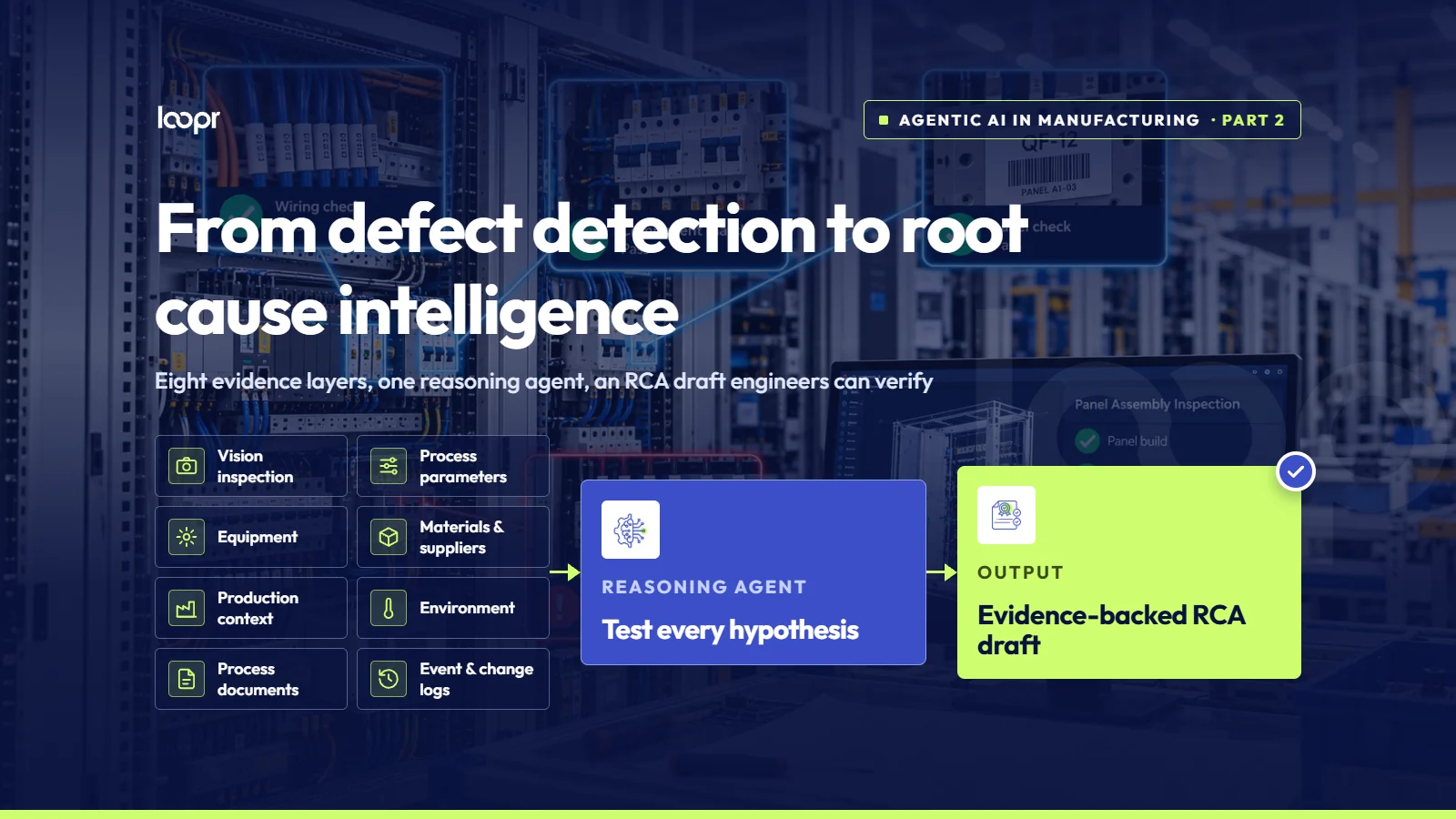
A single quality incident may span inspection images, process historian data, equipment health records, supplier lots, shift context and standard operating procedures. These sources are often fragmented across SCADA/PLC, MES, ERP, CMMS and quality systems. The difficulty is less about having no data than about retrieving, aligning and interpreting the right data in time.
A fictional example: coated-metal panel inspection
Imagine a coated-metal panel line whose vision AI flags coating streaks, edge-finish irregularities and color deviations. The inspection team observes a lower automated flag rate after a change in image-processing pathway. Did the actual product quality improve, or did the inspection system change what it reports? The agent must test both possibilities rather than attributing the trend to the factory.
In this wholly synthetic scenario, pathway A flags 42% of panels while pathway B flags 29%. The comparison deliberately illustrates a measurement problem, not a verified improvement: dates, product mix, camera conditions, thresholds and processing logic may differ. Automated flags are not the same as independently confirmed defects.
Illustrative: flag rates by inspection pathway
Automated flag rate (%)
Synthetic coated-metal panel example; differences are not evidence of better product quality.
How an agent would investigate
Where could it deliver value?
Quality investigations are an immediate use case, but the same architecture applies to equipment reliability, supplier-quality analysis, production bottlenecks and manufacturing knowledge retrieval. Its value should be measured in time to validated root cause, reproducibility of investigations, recurrence reduction and the quality of engineering decisions—not the apparent fluency of an AI report.
From reaction toward prevention
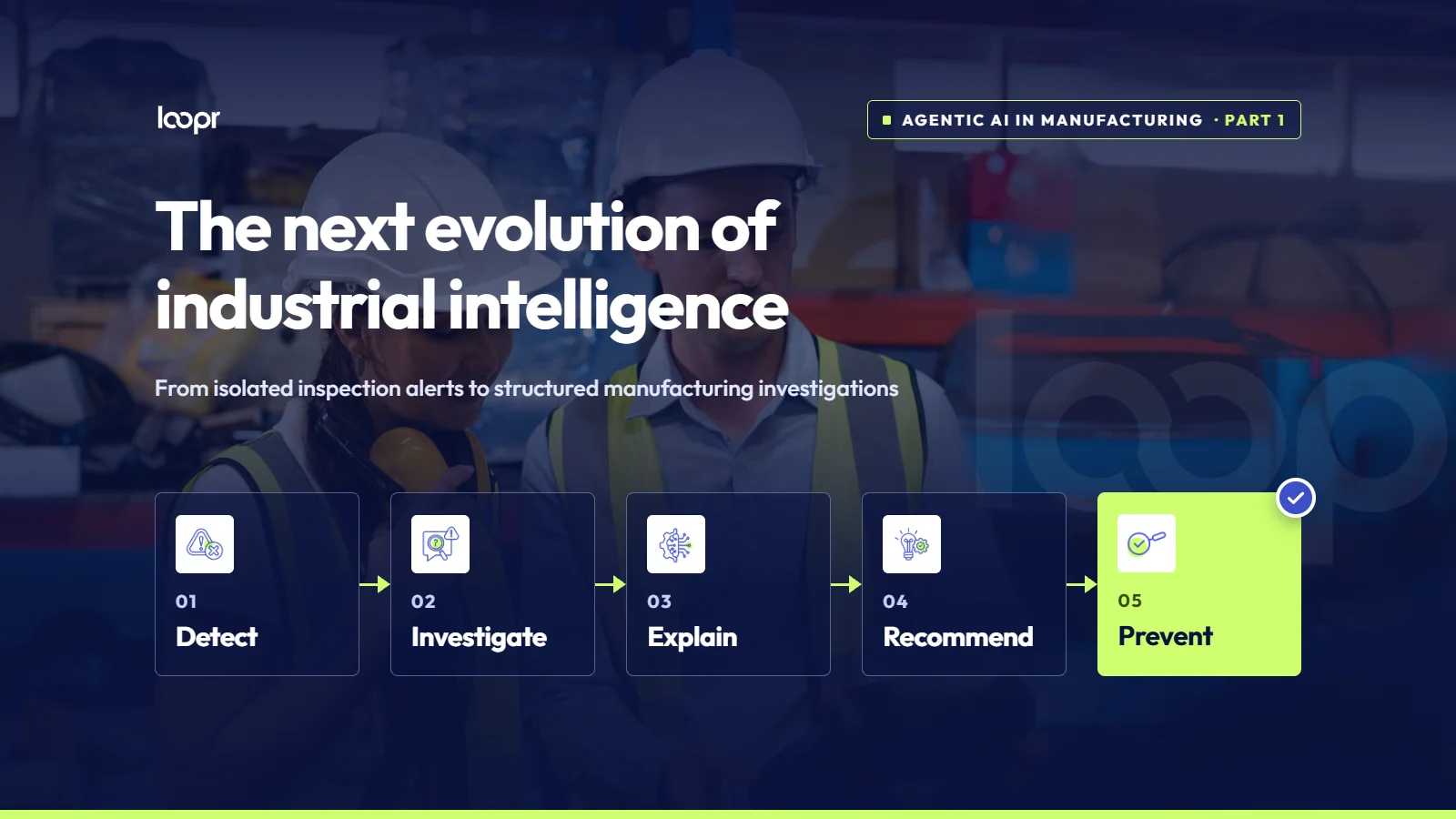
The maturity path is Detect → Investigate → Explain → Recommend → Prevent. Predictive alerts depend on validated historical relationships and robust monitoring. Physical actions require defined boundaries and appropriate human approval. The trustworthy agent is one that can also conclude: “Current evidence is insufficient.”
What comes next
Part 2 follows a fictional coated-panel case study into the proposed Loopr Process Reasoning & RCA Agent architecture, showing how an investigation can separate inspection variation from genuine production causes.
Editorial note: All charts and coated-metal panel figures in this article are synthetic illustrations, not Loopr customer results or manufacturing defect-yield claims. The conceptual workflow is informed by Loopr’s June 2026 Manufacturing Process Reasoning & RCA Agent briefing.