A multi-image inspection workflow should link each required view to a specific part and inspection attempt. It should also track whether the image set is complete separately from the inspection decision. Before using the workflow in production, define how it will handle missing images, duplicates, retakes and reinspections. A complete image set can support review, but it does not by itself prove product quality or authorize release.
Collecting several views creates a workflow challenge as well as a camera challenge. The system must know which part each image belongs to, which views are expected for that product configuration and how to handle late or repeated captures. NIST guidance discusses traceability and trustworthiness in manufacturing data, while OPC Foundation’s machine-vision specification describes linking results to part, measurement, recipe and configuration identifiers. These sources offer design context; they do not prescribe one implementation for every plant. (NIST)
Before you start
- Part identity: Decide what identifies a physical part at the station, such as a serial number or line-control event. Define what happens if the identity is unavailable or ambiguous.
- Product configuration: Establish how the system determines the applicable product or recipe version, and who controls changes to required views.
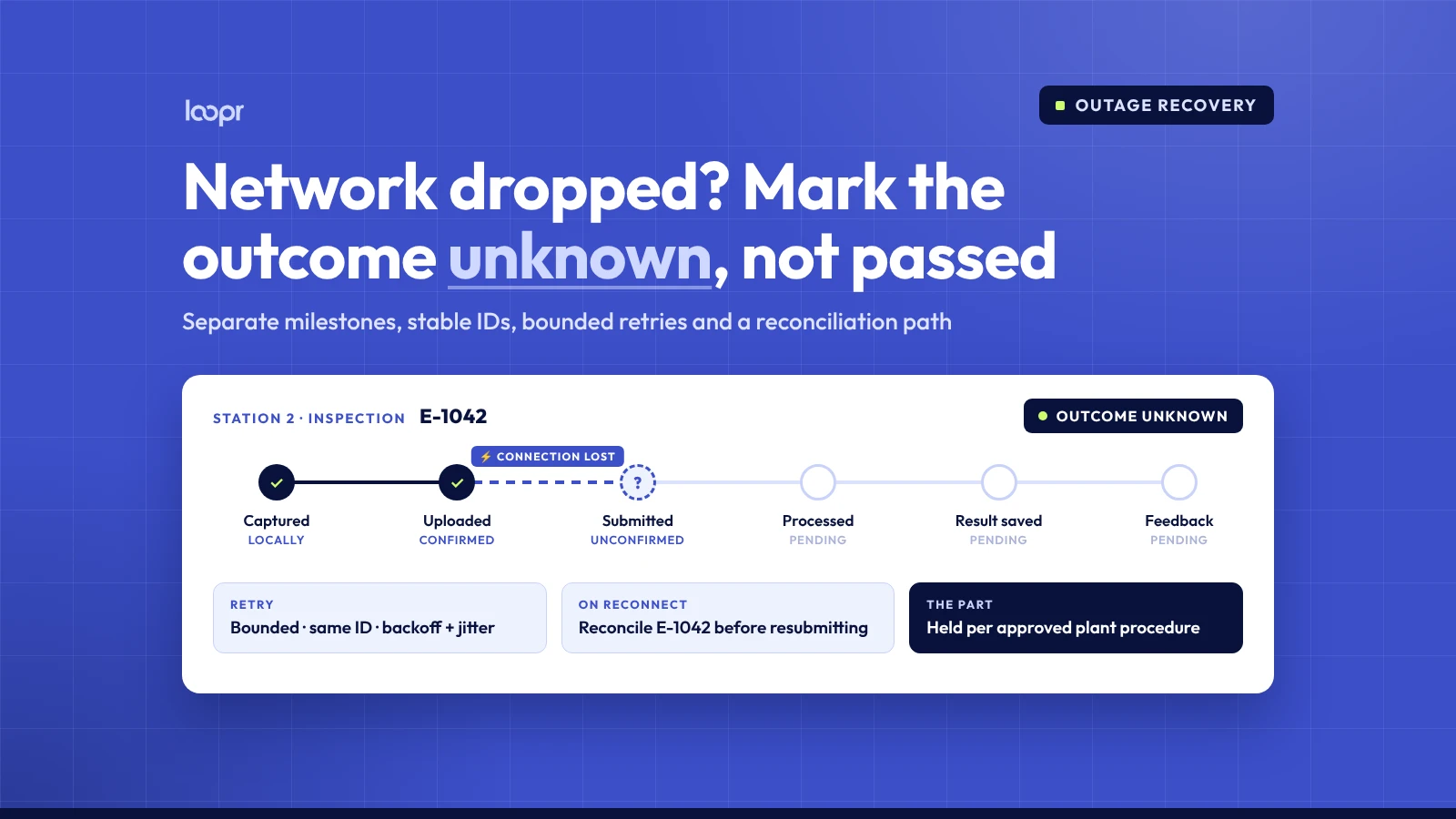
- Inspection attempt: Define what counts as a new inspection attempt. Distinguish a transport retry—resending the same capture or message—from a new attempt to inspect the part.
- View definitions: Give each required view a stable name or identifier, such as
top,connector_sideorlabel. A camera number alone may be unclear if hardware or station assignments change. - Decision authority: Document which system or authorized role determines pass, fail, review or release under approved plant procedures.
A useful record design makes the relationships explicit: part → inspection attempt → configuration version → expected views → capture events → inspection results → disposition decision. This is a design pattern to evaluate, not a claim about a particular software product.
If you’re deciding whether an inspection needs one angle or several cameras, our guide to choosing an AI visual inspection system covers the hardware-selection question. This article focuses on what happens to the images and records after the views are defined.
1. Define required views for each configuration
List the required views for every product variant or configuration that affects inspection. For each view, specify its identifier, the feature it is meant to show and whether it is mandatory for the inspection decision.
Version those requirements. When a view is added, removed or redefined, its applicable version should be identifiable in later reviews. Avoid silently changing an inspection recipe in a way that makes an earlier image set appear to have been collected against the new requirement. OPC UA for Machine Vision includes concepts for product, recipe and configuration identification and versioning, though details and available functionality depend on the implementation. (OPC UA for Machine Vision)
Ask: Could a reviewer later tell which views were expected when this part was inspected? If not, configuration identity needs more attention.
2. Establish the part and attempt before collecting images
Create or receive the inspection context before associating images: part identity, product configuration, station or process context, and inspection-attempt identity. The exact fields depend on the line, but the association must be clear enough to prevent a capture from one part being attached to another.
Keep part identity separate from attempt identity. One physical part may have an initial inspection, a retake of one view or a later reinspection. These events should not be confused with a camera or network retry that merely delivers the same capture again.
For each capture event, preserve enough identifying information to check its association—for example, the part, attempt, view, configuration version and capture time. NIST’s manufacturing-data report treats traceability as a data and system-design concern, while OPC UA for Machine Vision provides for part and result identification in relevant profiles. Neither source establishes that every camera or software stack already supplies these fields. (NIST)
3. Track completeness separately from pass or fail
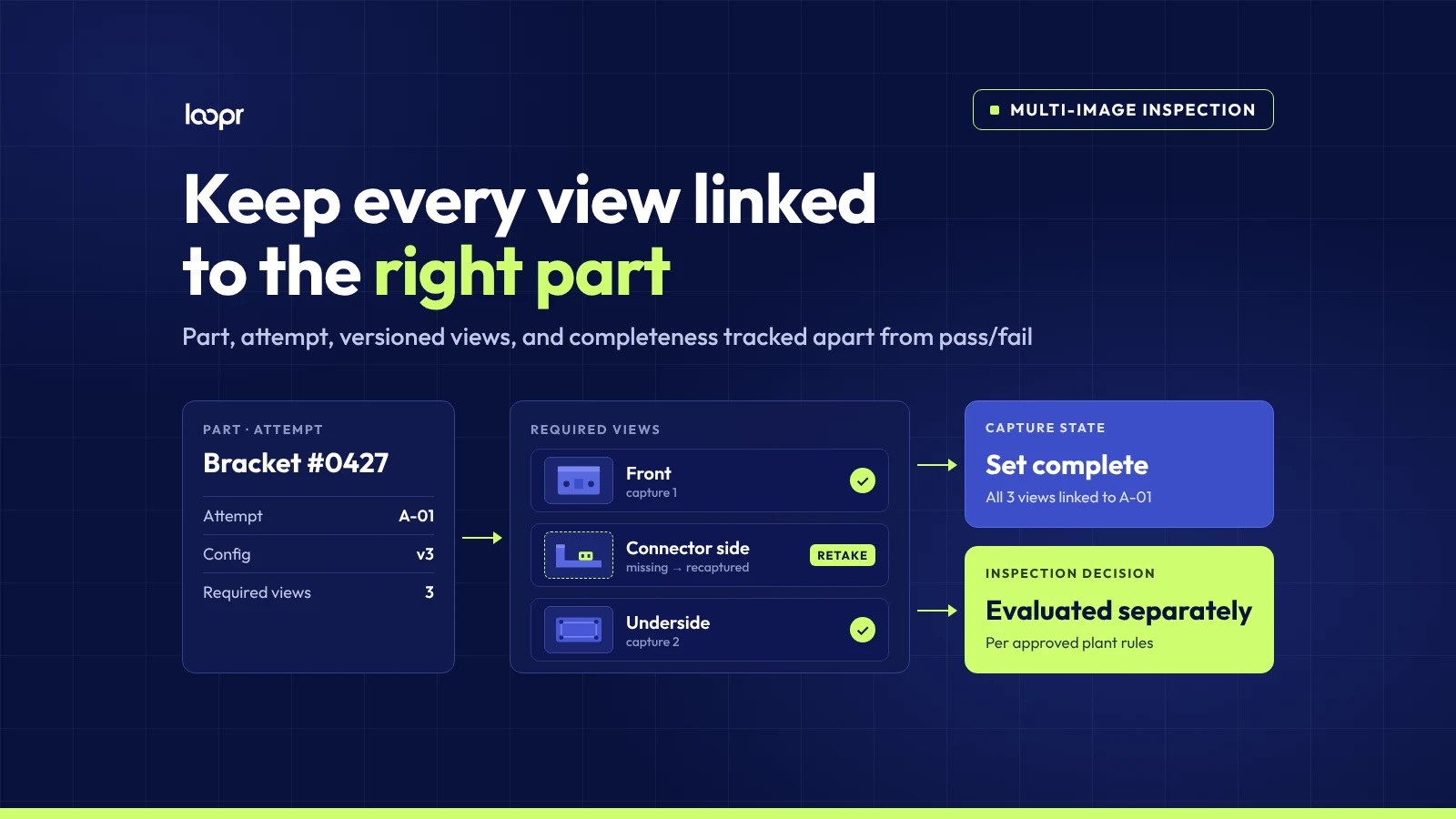
Represent capture state and inspection decision as separate information. A simple workflow might distinguish:
- Capture state: waiting, in progress, complete, incomplete or exception.
- Inspection decision: not evaluated, pass, fail or requires review.
This separation avoids an important ambiguity: an absent required image is not the same as a passed inspection. Likewise, a complete image set does not prove that all inspected features conform.
Define completeness against the view requirements for the applicable configuration and attempt. A set is not complete just because it contains the expected number of files; each required view must be identified and correctly associated. Decide how to flag an unrecognized view, a view associated with the wrong attempt or a capture that cannot be reliably tied to a part.
Apply documented aggregation rules only after the relevant inspection outputs are available. For example, a plant might require all mandatory views to pass, with a failed view resulting in a failed inspection decision and uncertain results routed for review. That is an illustrative policy, not a universal rule. Quality and operations teams must define the appropriate rule.
4. Define how to handle missing, duplicate and out-of-order images
Image events may arrive late, more than once or in a different order from capture. The workflow should identify what each event belongs to and how it affects the record, rather than treating arrival order as proof of inspection order.
- Missing view: Keep the set incomplete or in an exception state. Follow the plant’s approved procedure for holding, routing or reviewing the part.
- Duplicate delivery: Determine whether an event retransmits the same capture. Do not count a communication retry as a new view or inspection attempt.
- Out-of-order arrival: Associate events using identifiers and timestamps, not only the order in which a receiver processes them. Define what to do when the information needed to resolve the order is missing.
- Unexpected view: Record that the view was not expected under the applicable configuration. Route it through the appropriate exception process rather than silently substituting it for a required view.
These are design recommendations, not guaranteed behaviors of a specific system. Test them with the devices, network, controllers and software used on the line. For broader context on linking inspection information across manufacturing workflows, see our article on manufacturing traceability and real-time data.
5. Record retakes and reinspections without erasing history
A retake should replace an image’s role in the current evaluation only if the documented procedure says so. It should not erase the prior capture or the decision based on it. Keep the original capture and record the retake as a distinct event linked to the same part and appropriate inspection context.
A reinspection is different: it is a new inspection attempt on the same physical part. Keep its attempt identity separate from the first attempt, and define whether it uses the same configuration version or a newer approved one. Do not merge results from different attempts without an explicit, documented rule.
Record the reason for a retake or reinspection where procedures require it. A reviewer should be able to understand what was captured, what changed and which results informed the current decision. NIST’s traceability guidance and OPC UA’s discussion of recipe identity underscore the importance of preserving identifiers and configuration history. Implementation details still need to be verified in the system under consideration. (NIST)
Worked example
This example is fictional and illustrates the workflow.
A bracket configuration requires three views: front, connector side and underside. The first inspection attempt receives front and underside images, but the connector-side capture is missing. The image set is marked incomplete; it is not recorded as a pass just because the two received views look acceptable.
An operator follows the plant’s approved procedure to capture the connector side. That capture is recorded as a retake linked to the same physical part and inspection context. The missing-view event and earlier captures remain available for review. The configured inspection rule then evaluates the required views, and any final disposition follows the plant’s approved process—not completeness alone.
Checklist: Is the workflow ready to test?
Answer yes or no:
- Does every part or inspection event have an identity that can be associated with its images?
- Are required views defined for each applicable product or configuration version?
- Can a reviewer identify which version of the view requirements applied?
- Is an inspection attempt distinct from both a physical part and a transport retry?
- Is image-set completeness tracked separately from pass, fail or review?
- Are missing, duplicate, unexpected and out-of-order images covered by explicit rules?
- Do retakes and reinspections preserve earlier captures and decisions?
- Are aggregation, review and release rules documented under approved plant procedures?
A “no” is a useful design finding. Resolve it before relying on the workflow to support inspection decisions.
Limitations: What image association does not solve
Correctly linking images does not guarantee that a view is clear, representative or sufficient to detect a defect. Lighting, focus, occlusion, part positioning, camera timing and inspection criteria still matter. A multi-image workflow also cannot compensate for a part identity that is wrong at the source.
A complete image set records expected captures; it does not prove product conformity. Inspection thresholds, human review, escalation and physical disposition need their own validated rules and appropriate approvals. Do not treat this article as a compliance interpretation or authorization to release product.
Implementations vary. Do not assume your camera, controller, storage layer or inspection software supports versioned requirements, event deduplication, retained history or the exact status model described here. Confirm each capability and test failure cases end to end.
Next step
This week, map one product’s required views against its part identifier, configuration version and inspection-attempt rules. Walk through a missing view, a duplicate delivery and a retake with quality, automation and software owners. Record which events must remain visible and who is authorized to decide the part’s disposition.
Exploring AI visual inspection for your line? Learn about the Loopr platform.
Frequently asked questions
What is multi-image inspection?
Multi-image inspection collects or evaluates multiple views of a part as part of an inspection workflow. The workflow also needs rules for associating each view with the right part and attempt, and for deciding whether the required set is complete.
How should a system handle a missing inspection image?
Treat a missing required view as an incomplete or exception state, not a pass. The next action—such as recapture, review or routing the part—should follow the plant’s approved procedure.
What is the difference between a retake and a reinspection?
A retake is another capture of a view associated with the same inspection context. A reinspection is a new inspection attempt on the same physical part. Both should be distinguishable from a transport retry, which may simply resend an existing event.
Does a complete set of inspection images mean a part can be released?
No. Completeness indicates that the expected views have been accounted for under the defined rules; it does not establish that the part meets requirements. Product disposition must follow the plant’s approved inspection and release procedures.
Should images be processed in the order they arrive?
Not necessarily. Network or system behavior can change arrival order, so events should be associated using defined identifiers and relevant timestamps. Define an exception path for cases where order or association cannot be resolved.
Sources
- OPC UA for Machine Vision, Part 1: Control, configuration management, recipe management, result management — OPC Foundation. Provides concepts for part and result identification, and recipe and configuration identity and versioning. Functionality depends on implementation.
- Recommendations on Ensuring Traceability and Trustworthiness of Manufacturing-Related Data — NIST Advanced Manufacturing Series, 2020. Discusses traceability and trustworthiness as manufacturing-data concerns.
- How to Choose the Right AI Visual Inspection System — Loopr AI, published November 14, 2024. Covers single-view versus multi-view system selection.